Traditional Publishing vs. Self-Publishing: Which Path Is Right for Your Book?
Wondering whether to pursue traditional publishing or self-publishing? Compare costs, royalties, timelines, and creative control to choose the right path for your book.
Traditional Publishing vs. Self-Publishing: Which Path Is Right for Your Book?
Introduction
You've finally done it.
After weeks, months, or maybe even years of brainstorming, writing, editing, and rewriting, you've completed your manuscript. It's sitting on your laptop, waiting for the next big step.
But then comes one of the biggest questions every author faces:
Should you choose traditional publishing or self-publishing?
It's a decision that can shape not only how your book reaches readers but also how much control you have, how much money you earn, and how quickly your book gets into the world.
If you've ever wondered:
- Which option makes more money?
- Is traditional publishing still worth it?
- Can self-published authors become bestsellers?
You're in the right place.
In this guide, we'll compare traditional publishing vs. self-publishing in detail, covering the advantages, disadvantages, costs, royalties, marketing, creative freedom, and which option is best for different types of authors.
Let's dive in.
What Is Traditional Publishing?
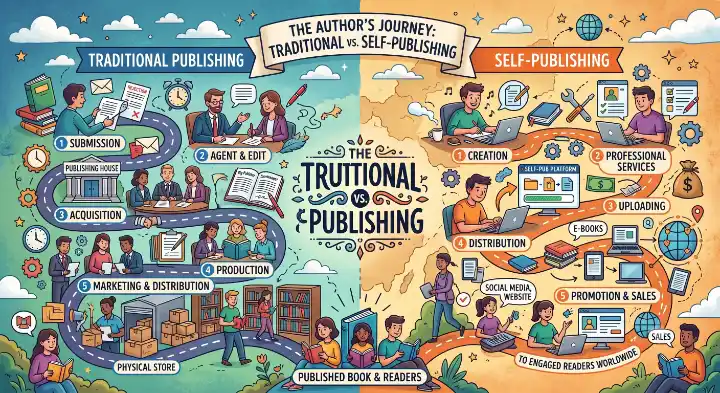
Traditional publishing is the classic route where a publishing company takes responsibility for producing, printing, distributing, and selling your book.
Instead of publishing the book yourself, you submit your manuscript to literary agents or publishers. If they believe your book has commercial potential, they'll offer you a publishing contract.
After that, the publisher typically handles:
- Professional editing
- Cover design
- Interior formatting
- Printing
- Distribution
- Marketing (to varying degrees)
- Sales to bookstores
Examples of traditional publishers include Penguin Random House, HarperCollins, Simon & Schuster, Macmillan, and Hachette.
How the Process Works
- Finish your manuscript.
- Query literary agents or publishers.
- Receive a publishing offer.
- Sign a contract.
- Work with editors.
- Book production begins.
- Book launches in stores and online.
Simple in theory—but getting accepted can be incredibly competitive.
What Is Self-Publishing?
Self-publishing means you're the publisher.
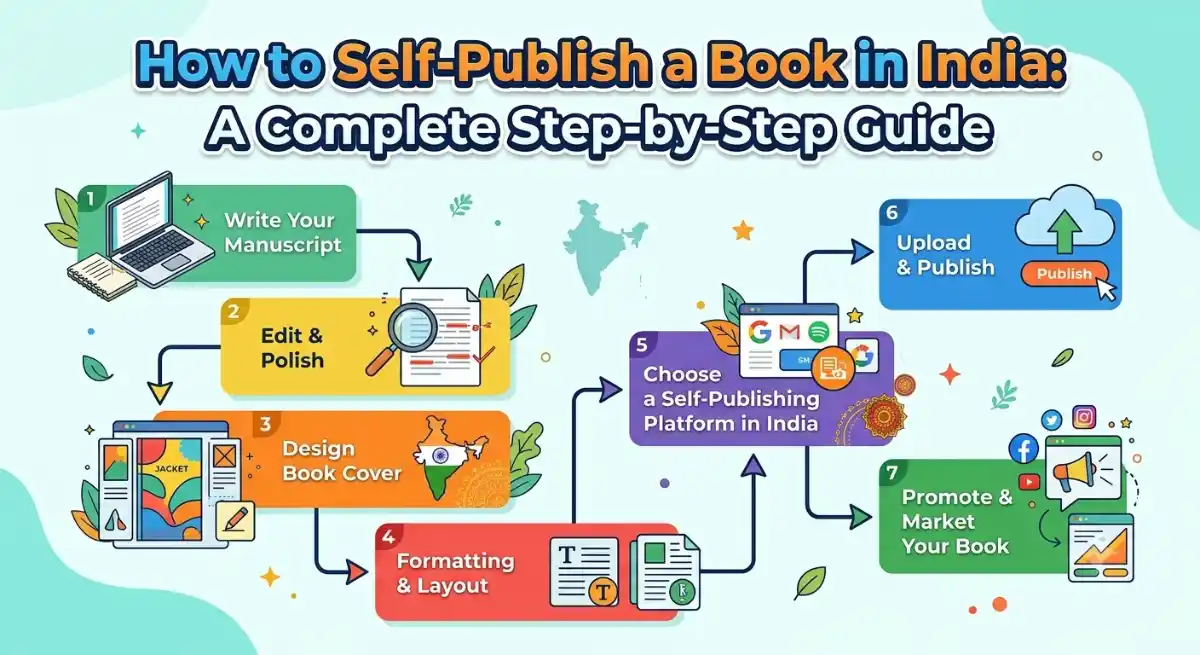
Instead of waiting for someone else's approval, you publish your book yourself using online platforms.
Popular self-publishing platforms include:
- Amazon Kindle Direct Publishing (KDP)
- Draft2Digital
- IngramSpark
- Kobo Writing Life
- Apple Books
As a self-published author, you make almost every decision:
- Cover design
- Editing
- Pricing
- Marketing
- Release date
- Advertising
- Book updates
In short, you're both the author and the business owner.
Traditional Publishing vs. Self-Publishing: Key Differences
FeatureTraditional PublishingSelf-PublishingCreative ControlLimitedCompleteRoyaltiesLowerHigherUpfront CostUsually nonePaid by authorPublishing SpeedSlowFastMarketingShared responsibilityMostly authorDistributionExcellentDepends on platformAcceptanceHighly competitiveAnyone can publish
Already noticing a pattern?
One offers support but less control.
The other offers freedom but more responsibility.
Pros of Traditional Publishing
1. Professional Credibility
Being accepted by a respected publisher can add credibility to your work.
Readers, bookstores, reviewers, and media outlets often recognize established publishing houses.
For many authors, this validation is a dream come true.
2. No Upfront Publishing Costs
The publisher usually covers expenses such as:
- Editing
- Cover design
- Formatting
- Printing
- Distribution
This reduces the financial risk for the author.
3. Better Bookstore Distribution
Traditional publishers already have relationships with bookstores, libraries, schools, and retailers.
That means your book has a better chance of appearing on physical shelves.
4. Expert Team
Imagine having professionals helping improve every aspect of your book.
You'll often work with:
- Developmental editors
- Copy editors
- Cover designers
- Marketing specialists
- Publicists
That's a major advantage.
5. Potential Advance Payment
Some publishers pay authors an advance before the book even launches.
Not every author receives one, but when offered, it provides financial support while you continue writing.
Cons of Traditional Publishing
Long Waiting Times
Publishing traditionally can take anywhere from one to three years.
Ask yourself:
Would you be willing to wait two years just to see your book released?
For some authors, the answer is yes.
For others, absolutely not.
Lower Royalties
Traditional publishers take a significant share of book sales.
Although you don't pay upfront, your earnings per book are generally much lower than with self-publishing.
Less Creative Freedom
Publishers may request changes to:
- Title
- Cover
- Characters
- Ending
- Marketing strategy
You won't always have the final say.
Hard to Get Accepted
Thousands of manuscripts are submitted every year.
Only a small percentage receive publishing contracts.
Rejection is common—even for talented writers.
Pros of Self-Publishing
Complete Creative Control
You decide everything.
Want a bold cover?
Go for it.
Want to change the ending?
No one's stopping you.
Want to update your book after publication?
You can.
Faster Publishing
Instead of waiting years, you could publish your book in days.
This is especially useful for:
- Non-fiction
- Educational books
- Trending topics
- Business books
Higher Royalties
Many self-publishing platforms offer significantly higher royalty rates than traditional publishing.
That means more income per book sold.
Global Reach
Within hours, your book can become available to readers around the world.
No warehouse required.
No printing company required.
Just upload your files and publish.
You Own Your Rights
Unlike many traditional contracts, self-publishing allows you to retain ownership of your work.
That's valuable if you later want to create:
- Audiobooks
- Movies
- Courses
- Translations
- Merchandise
Cons of Self-Publishing
You're Responsible for Everything
Publishing is only half the journey.
You'll also need to handle:
- Editing
- Formatting
- Marketing
- Cover design
- Advertising
- Promotions
It can feel like running a small business.
Upfront Investment
Professional books usually require spending money on:
- Editing
- Cover design
- Formatting
- ISBNs (in some regions)
- Marketing
While optional, these investments often improve quality and sales potential.
Discoverability Is Challenging
Millions of books are available online.
Without effective marketing, even a great book can struggle to find readers.
Which Option Makes More Money?
This question doesn't have a one-size-fits-all answer.
Traditional publishing may generate higher total sales because of stronger distribution.
Self-publishing often provides higher earnings per copy sold.
Here's the real question:
Would you rather earn a smaller percentage from a potentially larger audience—or a larger percentage while building that audience yourself?
Your answer depends on your goals, resources, and willingness to market your work.
Who Should Choose Traditional Publishing?
Traditional publishing may suit you if:
- You want industry recognition.
- You dream of seeing your book in bookstores.
- You're comfortable with a longer timeline.
- You prefer working with a professional publishing team.
- You don't want to manage the publishing process yourself.
Who Should Choose Self-Publishing?
Self-publishing may be the better choice if:
- You want full creative control.
- You enjoy entrepreneurship.
- You want to publish quickly.
- You're willing to learn marketing.
- You want to keep more of your earnings.
Can Self-Published Authors Become Successful?
Absolutely.
Many self-published authors have built loyal audiences and successful careers by consistently producing quality books and investing in marketing.
Success isn't determined solely by how a book is published—it's also influenced by the quality of the writing, the needs of the audience, effective promotion, and long-term persistence.
Tips Before Making Your Decision
Before choosing a publishing path, ask yourself these questions:
- What are my long-term writing goals?
- How important is creative control to me?
- Am I willing to invest time and money?
- Do I enjoy marketing and building an audience?
- Am I comfortable waiting for a traditional publishing timeline?
Your answers can provide clarity.
Frequently Asked Questions (FAQs)
Is self-publishing easier than traditional publishing?
Yes, because you don't need approval from a publisher. However, you'll be responsible for every stage of the publishing process.
Do traditional publishers market your book?
They often provide marketing support, but many authors are still expected to promote their books through interviews, social media, newsletters, and events.
Which option is better for first-time authors?
It depends on your goals. If you value guidance and industry recognition, traditional publishing may appeal to you. If you value speed, flexibility, and ownership, self-publishing can be a strong choice.
Can I switch from self-publishing to traditional publishing?
Yes. Some authors begin by self-publishing and later sign traditional publishing deals after demonstrating strong sales or building a dedicated readership.
Final Thoughts
The debate between traditional publishing vs. self-publishing isn't about finding a universal winner—it's about finding the option that best fits your goals.
If you value professional support, bookstore access, and industry recognition, traditional publishing may be the right choice.
If you want complete control, faster publishing, ownership of your work, and higher potential royalties per sale, self-publishing offers an appealing alternative.
The good news?
There has never been a better time to become an author. Modern technology has created more opportunities than ever before, whether you choose a traditional publishing house or decide to publish independently.
So here's one final question for you:
If your manuscript were finished today, which path would you choose—and why?
Whatever your answer, remember that the most important step is the one before publishing: writing a book that readers genuinely want to read.
Happy writing!
Crown Publishing
Dedicated to bringing author dreams to reality with standard self-publishing solutions across India.